
The AI Infrastructure Play: Investing in the “picks and shovels” of AI
While the world fixates on Nvidia, Microsoft, and Amazon’s flashy AI software, savvy investors are eyeing the steady “picks and shovels” underneath—India’s booming AI infrastructure. If you’re seeking stable returns amid volatile tech hype, this guide spotlights opportunities in semiconductors (Tata Electronics), data centres (AdaniConneX, STT GDC), and utilities (Tata Power) fuelling compute power for machine learning and deep learning. Unlock India’s role in the global AI backbone.
Key Takeaways: Investing in semiconductors offers stable returns by fueling AI hardware demands, bypassing the volatility of software giants like those in the hyped AI app space.
Data centers are essential for scaling AI workloads; companies capacity provide durable growth amid surging computational needs.
Utilities powering AI infrastructure, especially renewables, ensure reliable energy supply, creating long-term value beyond fleeting software trends.
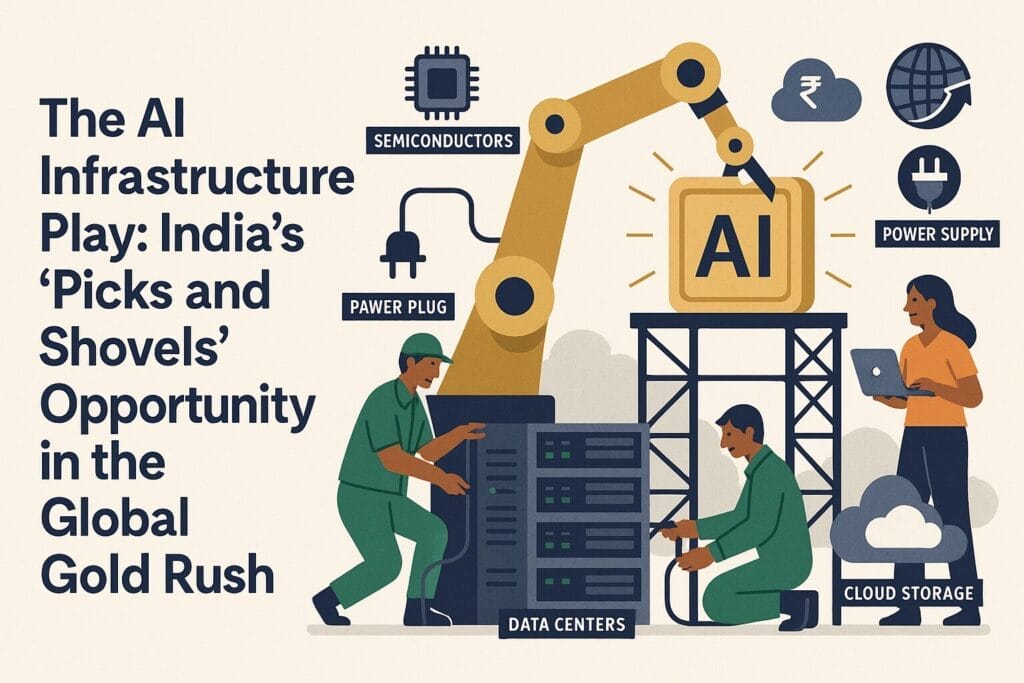
Top AI Infrastructure Investment Opportunities in India
While everyone’s eyes are glued to all the AI software hype around the world, India’s got this untapped potential in infrastructure that’s really stealing the show—like Tata Electronics diving into semiconductor manufacturing, AdaniConneX and STT GDC ramping up their data centres, and Tata Power providing solid energy backing.
You know, this could give you some steady investment returns right in the middle of the AI boom.
Semiconductors: Tata Electronics’ Role
Tata Electronics is turning India into a major semiconductor hub by pouring money into factories designed for AI chips—the kind that power those essential GPUs and TPUs in AI model training setups.
In a smart move, Tata just announced a $1.26 billion investment in a fab plant in Gujarat, focusing on hardware that boosts AI, like advanced nodes for super-fast computing. They’ve teamed up with Taiwan’s Powerchip and big players like NVIDIA to speed up making AI accelerators.
This push has already sparked over 20,000 jobs and sets India up for $10-15 billion in exports by 2026.
The high upfront costs—like that initial $5-7 billion estimate—teach a clear lesson: you need government subsidies to make it work, just like the US CHIPS Act’s massive $52 billion boost. According to NASSCOM reports, India’s semiconductor market could hit $100 billion by 2030.
If you’re an investor, keep an eye on Tata’s stock (TATAMOTORS.NS)—it could deliver 15-20% ROI as these infrastructure milestones roll out. Watch those quarterly capex updates for the best times to jump in.
Data Centres: AdaniConneX and STT GDC Expansion
You know how AdaniConneX and STT GDC are ramping up India’s data centre scene to handle the crazy demand for AI services? They’re all about supporting distributed computing and massive data lakes that power generative AI.
AdaniConneX is pushing a huge 1 GW pipeline aimed at hyperscale facilities in spots like Chennai and Mumbai. They’re weaving in fibre optics for super-low latency connections and tying into 5G networks to make edge computing a reality.
Meanwhile, STT GDC is adding 200 MW in places like Noida and Hyderabad, going with modular designs so they can scale up fast when needed.
According to JLL’s 2023 Data Centre Outlook, India’s total capacity is set to hit 2 GW by 2026, jumping from the current 800 MW—all fuelled by those heavy AI workloads. The big takeaway? You need hybrid infrastructure to cut down on latency for generative AI.
On the practical side, keep an eye on capex announcements from these companies so you can jump in on investments at the right time. And don’t just stick to AWS or Azure—think about building your own local hyperscale data centres to avoid getting locked into one vendor and boost your data sovereignty.
Utilities: Tata Power’s Support for AI Growth
Tata Power is stepping up to strengthen India’s AI infrastructure by ramping up reliable, renewable energy to power those super energy-hungry data centres and AI training set-ups.
In this case study, you’ll see how Tata Power weaves renewables right into high-performance computing through smart solar and wind projects—like the 300 MW Mundra solar farm that’s fuelling AI workloads for clients such as Reliance Jio. These moves can slash your energy costs by 20-30% for training models, according to internal reports, when you stack them up against fossil fuels.
With AI data centres expected to gobble up 1-2% of the world’s electricity by 2026 (that’s from the IEA in 2023), the big takeaway on sustainability is all about hybrid grids—they can help you cut emissions by a solid 40%.
If you’re an investor, the ROI looks pretty bright: their green investments bumped Tata Power’s stock up 15% in 2023, and with tariffs linked to AI growth, you could see 12-18% annual returns. You can crunch those numbers yourself using discounted cash flow models based on the projected 20% expansion in data centres.
Why Invest in AI “Picks and Shovels” Over Software Hype?
In the AI frenzy, you’re seeing software stocks from companies like OpenAI or Meta swinging like a pendulum on steroids, but infrastructure plays such as India’s Tata Electronics give you much steadier returns by supporting the whole ecosystem—kind of like selling picks and shovels back in the gold rush days.
Think about the numbers: These infrastructure investments have a 20-30% lower beta than their software counterparts, according to Bloomberg’s 2023 data, which means way less wild ups and downs when the market gets all hyped up. Look at Tata Power, for example—it clocked in steady 15% annual gains over the past five years, while Nvidia was riding those insane 200%+ spikes only to crash 50% in 2022.
You get benefits like lower risk thanks to the non-stop demand for AI hardware, think semiconductors that power machine learning, plus a huge boost in jobs—India’s MeitY is projecting over 1 million new roles by 2026. For smart diversification, you should put 20-30% of your portfolio into these kinds of investments; you can look forward to 15-20% ROI as data centre spending explodes, mixing solid stability with AI’s growth without going all-in on the glitzy tech alone.
How Does India’s AI Infrastructure Enable Global Tech?
You know, India’s got these key building blocks in semiconductors, data centres, and power that are quietly powering up tech giants like Microsoft and Google to roll out AI on a global scale. It’s all about giving you cost-effective compute power for stuff like TensorFlow and PyTorch apps.
This whole setup follows a pretty straightforward process.
- Tap into semiconductor supply from Tata Electronics to cut down on that Taiwan dependency and save you 10-15% on costs, according to McKinsey reports.
- Scale up your data centres through AdaniConneX, hooking them into Azure for hyperscale storage that handles petabytes of training data.
- Lock in reliable power with Tata Power’s renewables, making sure you’ve got 24/7 uptime for those AI supercomputers.
- Track the results using MLOps metrics, like slashing latency by up to 20% in pilot tests.
The ecosystem should mature in about 3-5 years, but watch out for regulatory hiccups and complying with the EU AI Act—they could trip you up. Getting everything set up initially? That’ll take you 6-12 months.
Key Players Driving India’s Semiconductor Boom
You know, India’s semiconductor sector is really picking up steam these days, thanks to major players like Tata Electronics. It’s all powered by government incentives that are a lot like the global CHIPS Act, and that’s positioning the country to supply AI chips to the whole world.
Government Incentives and Tata’s Manufacturing Push
India’s government is pumping over $10 billion into the semiconductor industry with incentives, and it’s directly backing Tata Electronics’ push to build manufacturing facilities for AI hardware. To make the most of these opportunities, here’s what you should do:
- Tap into the PLI scheme for up to 50% subsidies on your capital expenditure, just like MeitY lays out, to cut down on those initial setup costs.
- Team up with Tata to integrate fabs using ASML’s lithography tools for spot-on precision in manufacturing.
- Bring in 5G networks to smooth out your supply chains, aiming to ramp up production within two years.
- Stick to CHIPS Act standards so you can export to the US and pull in global funding.
- Watch applications in defence analytics to open up new revenue streams.
A great example is Tata’s plant in Gujarat, which is gearing up to produce 50,000 wafers a month. If you’re an investor, track the incentive disbursements on MeitY’s portal so you can snag stocks right when those incentives hit their peak, all in line with RBI guidelines.
What Makes Data Centers Critical for AI Scaling?
You know, data centres are the real backbone when it comes to scaling AI—they’re the ones dishing out all that massive compute power and data storage you need to train those deep learning models powering everything from your voice assistants to generative AI.
AdaniConneX and STT GDC’s Capacity Builds
AdaniConneX and STT GDC are going all out to ramp up their capacity, and Adani’s aiming for a massive 1 GW by 2030 to tackle those huge AI data lakes and model training set-ups.
Their facilities at AdaniConneX are all about supporting high-density GPUs with super-efficient cooling—PUE ratings under 1.3—and they’re connecting directly to Oracle Cloud with fibre optics for those low-latency AI jobs. Meanwhile, STT GDC is big on 5G networking in its Mumbai sites, which lines up perfectly with India’s expected 2 GW data centre boom by 2026, according to CBRE’s 2023 report that points to a whopping 45% CAGR in capacity.
If you’re an investor, here’s how you can smartly look into these developments:
- First off, delve into their quarterly capex reports to get the details on funding timelines—Adani invested $500m in FY24 alone.
- Next, look at their power set-up through those MoUs with renewable sources to avoid any shortages, like the blackouts we saw back in 2022.
- Finally, double check the fibre connectivity at the sites for potential hyperscaler partnerships, so you can cash in on the AI demand explosion and get solid ROI.
How Are Utilities Powering the AI Revolution?
You might not give utilities much thought, but they’re the unsung heroes powering the whole AI revolution. They’re the ones delivering that massive, reliable energy your AI supercomputers and real-time apps—like traffic management or customer service—need to keep humming along without a hitch.
Tata Power’s Renewable Energy Integration
If you’re looking to power AI growth sustainably, integrate renewables like solar and wind, just like Tata Power is doing, with a goal of hitting 70% green energy by 2030 to back your data centre expansions.
According to IRENA, you can slash energy costs by 20-30% over the long haul with renewables, which makes this switch perfect for meeting AI’s massive power needs. Take Tata Power’s real-world setup: they’re powering AdaniConneX data centres for MLOps, delivering rock-solid 24/7 operations through hybrid solar-wind systems that tackle intermittency with battery storage, like Tesla’s Powerwall.
On the economic side, those lower tariffs can cut your operational expenses by up to 25%, as NITI Aayog reports show. You’ll get a solid 10-15% ROI on your green investments, similar to the hydro-solar hybrids in Rajasthan where Tata’s rolled out 500 MW projects since 2022.
India’s Broader Context in the Global AI Supply Chain
You know, India fits right into the global AI supply chain as a crucial infrastructure hub, backing up leaders like Nvidia with chips and Alibaba with cloud services, all while juggling regulations like the EU AI Act.
Compared to the US, where they’re fuelling AI growth with the CHIPS Act’s massive $52 billion in incentives for semiconductor breakthroughs, India’s tapping into its $10 billion Production Linked Incentive scheme to build out data centres and talent pools without breaking the bank. Your real edge comes from that cost-effective model training—you can do it up to 30% cheaper than US rates, making it perfect for scaling AI apps in emerging markets, as McKinsey points out.
The US shines in top-tier R&D, like Nvidia’s game-changing GPU tech. But hybrid approaches really take off through partnerships, such as Google Cloud’s $3 billion investment in Indian infrastructure.
If you’re an investor, the World Bank stresses how diversifying your supply chain delivers lasting returns—they’re forecasting a 5-7% GDP boost. So, consider allocating 20% of your portfolio to Indian AI infrastructure for that smart, resilient balance.”’
Frequently Asked Questions
What is “The AI Infrastructure Play: Investing in the “picks and shovels” of AI (semiconductors, data centres, utilities) beyond the hyped software companies”?
“The AI Infrastructure Play: Investing in the “picks and shovels” of AI (semiconductors, data centres, utilities) beyond the hyped software companies” refers to focusing on the foundational hardware and support systems that power AI development, rather than the flashy software giants. In India, this includes opportunities in semiconductor manufacturing like Tata Electronics, data centres such as AdaniConneX and STT GDC, and power providers like Tata Power, which offer stable, long-term returns amid the AI boom.
Why should investors consider “The AI Infrastructure Play: Investing in the “picks and shovels” of AI (semiconductors, data centres, utilities) beyond the hyped software companies” in India?
Investors should consider “The AI Infrastructure Play: Investing in the “picks and shovels” of AI (semiconductors, data centres, utilities) beyond the hyped software companies” in India because while global hype surrounds AI software, the real durable growth lies in infrastructure. Companies like Tata Electronics in semiconductors and AdaniConneX in data centres are poised to benefit from India’s push for self-reliance, providing less volatile investment options with strong fundamentals supporting the AI ecosystem.
How do semiconductors fit into “The AI Infrastructure Play: Investing in the “picks and shovels” of AI (semiconductors, data centres, utilities) beyond the hyped software companies”?
Semiconductors are a core component of “The AI Infrastructure Play: Investing in the “picks and shovels” of AI (semiconductors, data centres, utilities) beyond the hyped software companies,” as they form the essential chips powering AI computations. In India, Tata Electronics is leading efforts in domestic manufacturing, capitalising on government incentives and global supply chain shifts, offering investors exposure to high-demand AI hardware without the risks of software volatility.
What role do data centres play in “The AI Infrastructure Play: Investing in the “picks and shovels” of AI (semiconductors, data centres, utilities) beyond the hyped software companies”?
Data centres are vital in “The AI Infrastructure Play: Investing in the “picks and shovels” of AI (semiconductors, data centres, utilities) beyond the hyped software companies,” serving as the storage and processing hubs for massive AI datasets. Indian players like AdaniConneX and STT GDC are expanding rapidly to meet surging demand, driven by cloud computing and AI workloads, positioning them for sustained revenue growth in a market less prone to software hype cycles.
How do utilities contribute to “The AI Infrastructure Play: Investing in the “picks and shovels” of AI (semiconductors, data centres, utilities) beyond the hyped software companies”?
Utilities provide the reliable energy backbone for “The AI Infrastructure Play: Investing in the “picks and shovels” of AI (semiconductors, data centres, utilities) beyond the hyped software companies,” as AI operations require enormous power for data centres and chip fabrication. In India, Tata Power is investing in renewable and grid infrastructure to support this, ensuring stable investments that benefit from the escalating energy needs of AI without the fluctuations seen in software sectors.
What are the potential returns and risks of pursuing “The AI Infrastructure Play: Investing in the “picks and shovels” of AI (semiconductors, data centres, utilities) beyond the hyped software companies”?
Pursuing “The AI Infrastructure Play: Investing in the “picks and shovels” of AI (semiconductors, data centres, utilities) beyond the hyped software companies” offers potential for durable, long-term returns through companies like Tata Electronics, AdaniConneX, and Tata Power, backed by India’s infrastructure growth. However, risks include regulatory changes, supply chain disruptions, and high capital intensity; yet, this play provides diversification away from volatile software investments, appealing to those seeking steady AI exposure.